One of the big challenges for non school based work experience in Australia, some internships or voluntary work, is the need for insurance cover to participate in the work place to see what job type may fit.
Photo by @thiszun (follow me on IG, FB) on Pexels.com
If your child has their eye set on a future profession or else wants to cultivate more experience trying different work environments, there can be the barrier of needing insurance cover. If the student is attending a school, the school will provide the insurance cover for the limited few weeks during school term. However home educated children are freer to explore their future of work as long as the insurance is attainable.
But what if your student is home educated, or your schooled child wants more experience during the holidays? What if your student is no longer registered as a student at all? What if you are a home educator? What then?
There are three options for work experience or Volunteer Worker’s Insurance:
Purchase insurance once off for the particular work experience, however, this can be in the many hundreds of dollars.
Whether a home educator or not, you can purchase a membership with the Home Education Network (HEN) for cover excluding Western Australia and Queensland for only $25. HEWA (formerly HBLN) for Western Australia cannot source work experience insurance and that continues to be a challenge there. HEN and HBLN are the only home education associations that have earned the trust of the home educating community to service home educator’s needs as an association for insurance purposes.
Some registering bodies also offer work insurance to home educating students, so be sure to contact your state registration body first to enquire if they can help you. Click here for a link to each body throughout Australia.
Or you can call your house and contents insurer and see if there is any provision for your student’s work experience to be included with your current package.
For further information on work experience in each state or territory, check out the Home Education Network’s page for helpful advice and links.
Ed Consult. Supporting Home Educators Across Australia.
As home educators, it is almost impossible not to be teaching our children in a cross curricular way naturally throughout our daily lives together making the learning stick.
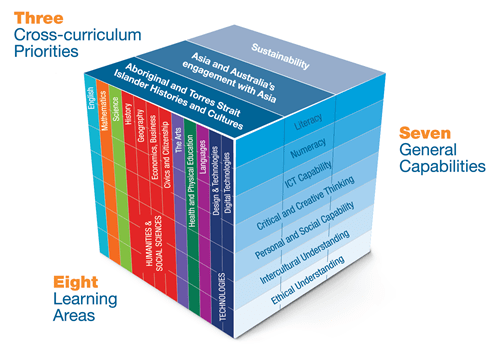
The Australian Curriculum as Cross-curriculum
The Australian curriculum and institutional schooling is usually organised into Knowledge Learning Areas (KLA’s) with a political and educational authority imposed hierarchy of knowledge with the key focuses of numeracy and literacy.
What do schools do?
Too often in schools and especially high school, knowledge silos are imbedded in the daily routine with time barriers and department divisions making multi-disciplinary learning just too hard to coordinate. One teacher’s timetable will clash with a teacher in another department or the grades won’t match up together on the same day. These divisions miss a major factor in the education of our children.
Research by the NSW DET as far back as 2003 demonstrated that the significance of knowledge to students was a key factor in the students’ development and understanding. Significance of knowledge to a student is only derived in psychological and the socio-cultural basis of how the student lives in order for them to be able to create meaning from the knowledge.
What do home educators do?
Here is where home educators excel. Unlike an institutional educational setting, as home educators there is no division between the students everyday lives and culture and their learning environments.
Home educators use the cross curriculum approach everyday effortlessly without knowing they are even doing it, in a way professional teachers could never achieve. If you are reading a novel series out loud to your children of different age groups, you are exploring, English, Music (I always like to play the orchestral sound tracks to the books we are reading such as Harry Potter or the The Lord of the Rings), Maths, Geography, History, Food Technology, Science, Industrial Design, critical thinking, Civics, Languages, creative problem solving, PDHPE, Art all across the curriculum. One significant novel read aloud to the whole family can tick the vast majority of the curriculum in one sitting. The learning is then extended into our everyday lives through the home educator weaving elements of the narrative through reminding the child of how Bilbo used his thinking skill of riddles or how Professor Snape managed his terrible dilemmas while cooking the dinner together.
This is highly significant for helping our children make the learning stick and for that learning to snowball into understanding, and the ability to extend themselves into more complex and creative problem solvers. A value that cannot be underestimated. Home educated children have a fertile educational environment that an institutional school cannot match. It is learning within the child’s personal culture that makes the knowledge significant and concrete.
Ed Consult. Supporting Home Educators Across Australia.
Any support for home educators in Australia is useful. Over a few posts Ed Consult will list a series of Federal Government policy changes that may be of use to home educators if we ask. It is also worth noting what is denied to the home educated student compared to their schooled peers.
Here are a few excerpts from the Australian Government Department for Infrastructure, Transport, Cities and Regional Development for 2020.
Extension of Preschool Funding Arrangements
“The Australian Government has committed a further $453.1 million to provide universal access to 15 hours of quality preschool a week in the year before school, through to the end of 2020, and to undertake the related National Early Childhood Education and Care Collection. This builds on the previous decision to provide Commonwealth support for preschool until the end of 2019 and will benefit around 350,000 children throughout Australia, 100,000 of whom are estimated to live in regional Australia.
The Smith Family School Student Support
An additional $1.4 million will be invested to fund work by The Smith Family to work with state and territory governments and disadvantaged communities on strategies to further improve preschool participation, particularly for families in regional and remote communities, including Aboriginal and Torres Strait Islander children.”
“The Australian Government will invest $3.3 million in three school-based arts education programs: Music Australia’s Music Count Us In, the Song Room’s Transformational Learning through Creativity, and Bell Shakespeare’s National Education Program. Together, the three programs cover all five elements of the Arts learning area of the Australian Curriculum—music, drama, dance, visual arts and media arts – and will promote student engagement and support students’ social and emotional wellbeing.
This funding will benefit an estimated 786,000 students and teachers in Australian schools and support delivery of these arts programs throughout Australia, with a focus on improving access to arts education for disadvantaged schools in regional and remote areas or low socio-economic areas.”
This is another initiative that may be useful for home education cooperatives. Contact your home education regulatory body in your state or territory to see if your local coop can be part of this scheme. You won’t know unless you ask.
Follow this blog to find out about other initiatives that are being rolled out by the Federal Government. Perhaps it is time to start asking for a piece of the pie.
Yes. Home Education is legal to practice in Australia.
There is provision in the Education Act of each state and territory in Australia for parents or guardians of children between the ages 5-6 to a registration period including over 17 years of age.
Home schooling – as form of compulsory attendance at school 2.1.1 – disclosure of information regarding 4.9.4 – information for school attendance officers 5.8.5 – protection of details of students registered for 4.9.1- registration of students for 4.3.9 – review of decisions regarding 4.8.1
There is an academic resource by Glenda Jackson and Sonia Allan, published 2010 which discusses issues of registration and legislation in Australia on home education.
Ed Consult. Supporting Home Educators Across Australia.
But what do I teach my child? How will I know? Is there a road map or GPS? Relax, there is quite a lot of information provided by each registration jurisdiction across Australia to help you get started with the paper work and road map.
In all states and territories across Australia, there are links to the State or Territory version of the Australian Curriculum on the state or territory home education pages. When registering you generally refer to your state or territories’ version of the Australian Curriculum however in Tasmania for example you only need to develop a plan that includes subject areas and how you will cover those areas. Go to the registration body in each area to find out more:
Click through the links to find the link of each curriculum and learn the broad areas you are required to have in your Individual Learning Plan (ILP) for each child. This ILP may be over different stages and not all within a single “grade” level. The joy of home education is that the learning plan can adjust to where your child is, rather than what grade their age may place them if in a school.
In general, focus on reading, writing and arithmetic for the primary education years, and then in secondary levels with elective subjects to focus on their interests and special skills to help them develop those skills further. English is a focus for the whole of the child’s education, with maths, geography/history, and science as the core subjects. The other subject areas are at the child and educators’ discretion within the rules for choosing elective subjects of your education region.
For the more stringent home ed registration states in Australia, generally, a cut and paste of each Key Learning Area (KLA) stage statements into a word document with a list of resources or strategies you intend to use for the next registration period, will suffice for the learning plan prior to the home visit in the states and territories where they have them.
In South Australia, when applying for home education, it isn’t called registration due to differences in the Education Act. In SA you need to apply for exemption from school after you register your child at your local school as a student. This process is managed by the principal of the school.
If you have not registered for home education, and somehow the Government becomes aware of this, they will simply contact you and ask you to register or apply for exemption. There are no direct penalties for not registering your child for home education across Australia. If you persist with not registering your child for home education against the directions of the registering body, then the most drastic scenario is that you could be charged with educational neglect. However, this is very rare in Australia with regards to home education.
There is no registration body, that will try to match the ILP with the parent written report upon re-registration the next time. Life happens and learning needs change. The learning that occurred may resemble in a very limited way the learning plan you were initially registered under. Just keep some basic records as you go across the curriculum areas of your child’s educational experiences and the re-registration process will be successful.
Ed Consult. Supporting Home Educators Across Australia.
Over the past 20 years, pathways to tertiary education have expanded dramatically. This has significant implications for students who are both home educated and schooled students.
This is the first of four blog posts on the subject of alternative pathways for home educated students. Be sure to subscribe to read them all to be fully informed on many of your options.
One of the common negative comments heard by the home education community is that home educating your child will rob them of a successful future. This could not be further from the truth.
There is no specific limitation preventing a home educated child gaining access to higher education and a satisfying career.
There are many pathways to careers, and ways to gain access to relevant university courses, TAFE and other qualifications. Completing year 11-12 in any state or territory in Australia is but one of those pathways; some home educated students may choose to attend mainstream school for years 11 and 12.
It is not the strongest … that survive, nor the most intelligent, but the ones most responsive to change.
Charles Darwin –
In this series I will be looking at some, but not all pathways into tertiary education.
However, home educated students can enter tertiary studies in any number of other ways. Here are a few of those entry doors:
A TAFE Certificate qualification, studied on campus or online, through TAFE or another private RTO (Registered Training Organisation) can be a good transition from home education to a career, or a pathway to a University degree. A student 15 years or older can apply for many courses without any prerequisites, simply by applying online directly with a course provider. See the Ed Consult Blog for NSW TAFE for more information. Always inquire about any government funded placements when enrolling, especially if you are a health care card holder.
If your student wants to complete a university qualification they will need to determine which pathway to use. Once your student has identified the desired course and the university, consult the Course Handbook which is available on the website of the University, and look at what first year subjects are studied and any assumed knowledge, in order to identify ways of demonstrating the student’s competence. You may contact the university entry administration and discuss your situation with them. Ask for a contact in the specific faculty to talk directly to the Head of Department about prerequisites that that particular course may require. This is also an opportunity to show a student’s portfolio of related work as a simple entry in without any other requirements.
The following options are but a few of the other possible pathways. In my experience of tertiary education, the administrators don’t necessarily know all the answers and can give poor advice, especially as an alternative pathways candidate. Always check with the faculty directly on the requirements.
Most institutions offer alternative entry to applicants who do not meet the usual admission requirements. When considering your application, institutions may take into account the following:
Distance education and curriculum providers may provide completion certificates
Tertiary preparation courses
TAFE courses also offering pathways to university
Open University units
Scholastic Aptitude Test or SAT 1 results
Special Tertiary Admissions Test or STAT results
Alternative entry schemes and programs which are provided by the universities themselves
Professional/paraprofessional qualifications
Employment experience
Aboriginal and Torres Strait Islander origin.
It is really important that you check if any of these options are accepted before choosing this pathway for the particular university course that the student wants to pursue. Ask lots of questions and share your learning with administrators if you think they are giving you the wrong information. Be Brave, be bold but be kind too, and you could be helping fellow home educators who come after you.
Subscribe to Ed Consult blog to stay up to date with this special on Pathways to Tertiary Education series.
Ed Consult would like to thank Beverley Paine, Susan de Wall, Zsa Zsa Kiss, and Tamara Kidd for their support and input into this research project. Thank you.
Ed Consult. Supporting Home Educators and Parents Across Australia.
This is the fourth and final blog in this special series on alternative pathways for entry into Tertiary education. To get the full story, click on this link here.
Many universities offer alternative pathways courses, allowing a student to begin studying at the University of their choice, while gaining admission to their chosen degree through enrolling in single subjects first.
For some degree courses with higher ATAR entry requirements such as medicine of Vet science, it is possible to transfer from a different degree. By choosing appropriate courses in the first semester, and achieving good results, transferring is not difficult. Contacting the institution for advice is recommended.
Since January 2020, both RMIT and UNE have make a policy preventing students under 16 years of age from applying for courses. This change is new and without any justification provided. Subscribe to Ed Consult to keep up to date with changes such as these.
A good investigation into which university to choose should also include a look into feedback from student experience, graduate employment, Graduate Satisfaction and Employer Satisfaction. Some students will just have to use the local university, but if you can choose, than choose with confidence through Quality Indicators for Learning and Teaching. Simply type in the course and institution and see what others have to say.
When applying, do also include evidence of any paid or unpaid work experience that is related to the field of study the student is applying for. This could be a letter of reference from the employer or evidence of a period of working in a particular industry through payslips.
Apprenticeships are another pathway, combining TAFE study with paid practical work in order to complete the qualification. Apply directly for an apprenticeship through 1300 Apprenticeship online or apply through an employer such as a local hairdresser or electrician for example. Any certificate IV course is considered as the same level as the final year of high school and is a clear pathway to study at university.
Also, remember to apply for any scholarships or fee reduction opportunities. These are often found on the website of the institution. There are so many opportunities out there, however you may need to ask a lot of questions in order to find out about them.
Home educated students can begin in their early teens to explore careers, and pathways to further education to help them to fulfill their personal talents and aspirations. Non-year 12 certified students can access a wide variety of pathways to enter tertiary education, and to gain qualifications towards any career they choose, and anyone who suggests otherwise is simply wrong.
Ed Consult. Supporting Home Educators and Parents Across Australia.





 Ed Consult