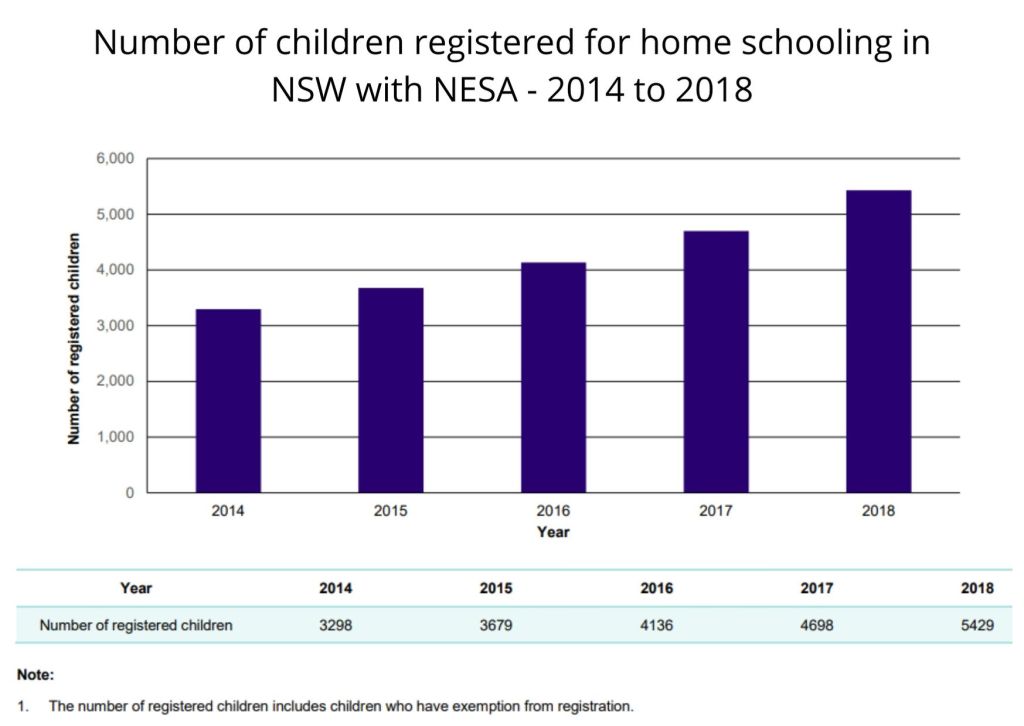
NSW in Focus – How many home ed students are there? 5,429 in NSW.

New South Wales

The latest numbers of students registered for home education are from a report March 2019 from NESA (NSW Education Standards Authority). From 2014 with 3298 to 2018 with 5429 home educating students. The number of unregistered students is unknown but anecdotal evidence suggests it could be a similar figure.

“New South Wales has experienced a 24% growth between 2014-2016, following a dip after the introduction of new regulations in 2014. At the time, there were 3,327 students registered for homeschooling with the NSW Board of Studies [now NESA], which has now grown to 4,100 respectively.

Victoria and NSW account for 54% of homeschool registrations nationwide.” – The rise of home education in Australia February 2019.

Home Schooling Data reports relating to 2018 – March 2019

This graph is interesting as it shows the percentage of home educators who are being given shorter registration periods. Using 5,429 as the 2018 figure, the students registering for the first time who got the full 12 months initial registration was 78% with renewal of registration receiving the maximum time period of 24 months was up at 87%.

It would be interesting to see what plans or reporting is being rejected or given shorter registration periods by NESA so that we can all learn what not to do when registering.

How many schools would it take to educate 5,429 students in NSW?

Not home education.

Approximately 105 Primary School classes just like the one above, and 90.5 high school classrooms to accommodate all the home educated students with a 50/50 spread of primary to high school students. This is just a representation of what that many students may actually look like with the average primary school class of 26 students and high school class of 30 students. Financially, at an average of $16,000 per student for tuition (not accounting for additional learning support funding or infrastructure funding) would cost the Federal Government approximately $86,864,000 if all home educated students were to enrol next week.

If we were to acknowledge the 1/4 of all registration applications in NSW that choose to state that they home educate with a child with special needs, including levels 1-6 of $6,400 to over $60,000 per student per year, this could equate to a total funding for all home educated students to over $115,000,000 per year.

Just as soon as the latest numbers from NESA on registration for home educated students are available they will be shared with you here. Don’t forget to subscribe.

Ed Consult. Supporting Home Educators Across Australia.

NSW in Focus – How to Register for Home Education

Registering for home education in NSW is straight forward and easy. If you know how.

You will need to follow a few steps as listed below in order to successfully register for the maximum first registration period of 1 year. Upon re-registration in 12 months time, you can apply for a two year maximum registration period. NSW home educators register through NSW Education Standards Authority also known as NESA.

How to make the big bad government Authorised Person smile on your home visit. Only joking!

Step 1 – Alert the authorities that you are leaving the reservation

Go to the NESA homeschooling webpage and download Form 1 for initial registration. Fill one out for each child separately and then email them back signed. An AP (Authorised Person, usually a teacher) will then call you to make an appointment for the purposes of sighting your children and to read a written program for each child.

https://educationstandards.nsw.edu.au/…/home-schooling…

Step 2 – Write your plan

The program can be as simple as cutting and pasting the stage statements from each Key Learning Area (KLA), and then list any resources you intend to use to cover those skills sets in the stage statements.

I wouldn’t write any education philosophies down. Stay away from mentioning unschooling or natural learning and save yourself an unnecessary headache. Just list resources or activities that will tick what each stage statement will need.

You only need to register for primary or secondary school. You do not need to list a grade level. This gives you the freedom to alter the skills levels for each KLA to suit where your child is upto. If they are more advanced in Mathematics you may select the stage statement for stage 3 instead of stage 2. This is your opportunity to truly tailor your child’s education.
Click here for all the stage statements in a single document for Early Stage 1 to Stage 5. Stage 6 is separated due to the volume of subjects and different requirements in the Curriculum.
https://educationstandards.nsw.edu.au/…/stage…

If you are using work books, your list of resources under the stage statements for English and Maths KLAs may look something like this:

  • Mathematics stage 2 – Targeting Maths grade 3, Life of Fred, online multiplication games.
  • English – All About Spelling level 4 – 5, First Language Lessons, Writing with Ease, The Hobbit and The Lord of the Rings for literature, readers from the library, Audio books, speech at home school group.

If you are using a child led approach or unschooling, you will still need to write something down and that may look like this:

  • English – Public speaking at the home school meet-up, writing a journal, creating a recipe book, creating an ad for selling a bike on Gumtree, memorising poetry from a nursery rhyme book, writing some short stories, doing some copy work, keeping a word index book of words learnt with meanings, reading list appropriate for their interest and age.
  • Mathematics – focusing on using measuring equipment especially in cooking, online maths games, chalk and cement for practice problems, building with lego, sorting colours and quantities and following instructions, shopping adding up the purchases, planning a family trip with public transport, playing math based card games like Gin Rummy, playing board games like Ticket to Ride or Rummikub, singing along with the times table song disc.

It really isn’t very hard. Do the simplest paperwork such as listing of resources above is all you need to write. Be polite to the Authorised Person and then get the government out your front door. What you do in your home is your business. The longest registration period you will get for the initial registration is 12 months. Some home educators have really great APs and they are a welcome resource during home visits, but some have reported APs who expect school at home setups and can be highly rigid in interpreting their jobs. Do let Ed Consult know if you have had an experience such as this at contact@edconsult.com.au

Step 3 Get re-registered for your next home education adventure together

In 12 month’s time you print off the second form on the above mentioned NESA webpage and then have some work samples for each KLA, a photo album, diary entries or some form of record keeping of their learning and the new plan for the next two years. You are not required to compare your registered plan with what work was actually reported on. The AP is simply noting that you have a plan that is consistent with the NSW Curriculum. If you do nothing that you planned to do, that doesn’t matter at all. Just report what was done. Not hard really.

What if I don’t register?

Under the Education Act (see my other blog on this topic) in NSW you are required to register with NESA to home educate. If you are not registered, the only thing that will happen is that you will be asked to register with NESA. If you persist to fail to comply with the above steps, then the end worst case scenario is that you could be charged with “educational neglect”. This is very very rare and reserved for those who repeatedly refuse to register under the act.

If you are reported, simply register your children. Children who have never attended any schools are not on any lists. Children who unenroll from a school will be on the list of the school or a home school liaison officer and you can expect a phone call enquiring why your children are skipping school without a note.

Just say what the government wants to hear.

  • Yes we use the NSW Curriculum
  • Yes we keep records of the learning
  • Yes I considered my child’s learning needs and interests
  • Yes we have resources and space available to facilitate the learning of my child.

Job done.

Ed Consult. Supporting Home Educators Across Australia.

Video – Federal Government Funding Policies 2020

Video

Any support that home educators can take advantage of is a help. As home educators, you cannot ask to partake in funding initiatives if you don’t know about them.

Read a series of blog posts below exploring possible funding policies that may be utilised by home educators across Australia if you ask.

Ed Consult. Supporting Home Educators Across Australia.

Difference Between Home Education and Distance Education

In home education groups online, there is often confusion over what the difference between Distance Education and Home Education entails.

Distant Education is still school, but done in the home environment. A school is still responsible for delivering the subjects covered with the students sometimes expected to be online at certain periods of the day or on the phone to the teachers at specific times. The parent acts like a teacher’s aide responsible for the supervision of the educational materials emailed to the students or delivered on an online learning platform.

For this kind of education, you generally need to be home 5 days a week (or at least within internet access) during school hours of the distance education provider, so if you are interstate, you will need to keep the time change in mind.

The benefit of distance education is that the parent is absolved of developing any learning plans and registering those plans and work samples with the state education departments.

The downside to distance education is that you lose the right to choose how you spend your days. Without the freedom to go to home education meet ups, valuable social opportunities are lost. The learning opportunities provided are also still a one size fits all with minimal modifications for the individual learning needs of the student.

Distance Education really can work well for some kids, but not so great for others. It is a real choice, however in order to gain access to the state run distance education as a public student, you would need to have a medical reason or a geographical reason for not attending the local public school near you. The only other way to access distance education is through registered private providers that can be interstate and expensive. But if that is a good option for you then explore it. There will be further blogs in the future on some funding that is provided to eligible distance education students so subscribe to Ed Consult blog to learn more.

Home education on the other hand is all delivered, and developed by the parent or guardian of the student and the requirement is for that home educator to register for home education or in South Australia’s case, to apply for an exemption from schooling after enrolling in their local state school. 

The benefits of home education over enrolling in a distance education provider is that your days are you own to do with as you please. You can also tailor a personal learning plan for your child rather than a one size fits all.

Home education is a particularly good option if you are travelling with kids. You can tailor the learning to be relevant with where you are on your journey to really help make the learning stick.

The number of family trips around Australia that I have heard being ruined by the need to be near a good internet signal to connect with their teacher, is rather high. Home education is definitely the way to go for that year long family journey around Australia. If you would like any support in developing your registration plan for your big family holiday, don’t hesitate to email contact@edconsult.com.au to explore your options together.

Ed Consult. Supporting Home Educators Across Australia.

HEN – Home Education Survey Across Australia

The latest survey run by Susan Wight of the Home Education Network also known as HEN, a national association for the promotion and support of home education in Australia.

This year’s survey saw the highest participation rates from outside of Victoria with a total of 592 respondents from every state and territory across Australia. It is an anonymous survey as no identifying information was collected. Click here to see the results yourself.

Some of the questions covered included:

  • categorising their reason for home educating. 45% stating it was a matter of philosophy and 55% as a response to school experiences.
  • The section of the survey for rating the main factor for home educating initially was for “a tailored education” 
  • whereas the main factor for continuing to home educate was “happier kids” with 223 respondents.

When looking at the different styles of education being provided at home, “Unschooling” is most popular in Victoria and Queensland, and “Project-based learning” is most popular in NSW and Queensland.

The socio-economic status of respondents showed a fairly even spread through low to high household financial status.

The occupation of respondents with the most frequency of 8% was “teacher”.

The registration status of the respondents was around 92% nationally however Queensland had the fewest registered home educators of 74% of respondents. 

More survey participants are needed to give a broader view of the actual registration status of home educators in Australia, registered and unregistered. As Susan Wight from HEN said “If we could hit 10% across the country, that would really help home educators in each state make solid arguments when advocating. Without our own stats, the government owns the narrative.”

So stay tuned for the next call for nationwide participation in this important voluntary project to support home education in Australia by the Home Education Network. Subscribe to my blog Ed Consult and this youtube channel to keep informed by clicking on the subscribe button or clicking on the links in the information below this video.

Consider joining the Home Education Network to further support the research and support projects for home educators across Australia. HEN costs only $25 per year for membership with a magazine and tonnes of online support. Click here for more information.

Find out why people home educate, and much more. Jan 2020

Ed Consult. Supporting Home Educators Across Australia.

Federal Government Funding Initiatives 2020 Blog Series #5

This is the fifth blog on Federal Government Funding Initiatives for 2020.

Here are the next excerpts from the Australian Government Department for Infrastructure, Transport, Cities and Regional Development for 2020.

Online Teaching and Learning Courses—support mathematics and phonics

The Australian Government will provide $9.5 million over four years from 2019-20 to strengthen the capacity of teachers across Australia to teach mathematics and phonics through freely available, nationally coordinated, high quality professional learning and resources. This initiative will deliver:

  • Mathematics Massive Open Online Courses (MOOCs) for teachers of Foundation to Year 10 students, provide supporting face-to-face professional learning and a repository of teaching and learning resources through an online Mathematics Hub. It aims to inspire Australian school students to learn mathematics and equip them to become our future mathematical and technological innovators.
  • Online learning and teaching resources to support phonics education for the early years of school. This initiative will provide teachers with ready access to teaching and formative assessment resources to ensure the students who need the most support to learn to read get the help they need.

The online courses and resources will be freely available to all Australian teachers and students, with resources being readily accessible to those living in rural and remote locations, and Aboriginal and Torres Strait Islander people. The mathematics and phonics online resources are designed to support teachers and provide professional learning opportunities.

Ed Consult has written to the Federal Minister for Education Hon Dan Tehan, to enquire where these resources can be found and if home educators are able to utilise these opportunities too. Stay tuned to find out more when a reply is received. This may take many months though.

See a list of other blogs in this series as they are published:

Follow this blog to find out about other initiatives that are being rolled out by the Federal Government in 2020. Perhaps it is time to start asking for a piece of the pie?

Ed Consult. Supporting Home Educators Across Australia.
Link

Whether you are pro-regulation in Australia, ambivalent, or positively against any Government interference in the home, this is an interesting read from our cousin home educators in America.

“We” Should Not Regulate Homeschooling by Kerry MacDonald Tuesday, January 7, 2020

“Modern homeschooling encompasses an array of different educational philosophies and practices, from school-at-home methods to unschooling to hybrid homeschooling.”

Ed Consult. Supporting Home Educators Across Australia.

Federal Government Funding Initiatives 2020 Blog Series #4

This is the fourth blog on Federal Government Funding Initiatives. See here for a list of other blogs in this series as they are published:

Any support for home educators in Australia is useful. Over a few posts Ed Consult will list a series of Federal Government policy changes that may be of use to home educators if we ask. Ed Consult does not endorse any of these Government initiatives. They are simply a collection of policies for 2020 that home educators could make use of for their families.

Here are the next excerpts from the Australian Government Department for Infrastructure, Transport, Cities and Regional Development for 2020.

National School Reform Agreement—Commonwealth contribution to national policy initiatives

“The Australian Government will contribute to the costs of implementing national policy initiatives developed with the states and territories to support implementation of the National School Reform Agreement. The initiatives will focus on strategic reform in areas that will have the most impact on student achievement and school improvement, to support every child to realise their full learning potential. By signing up to the Agreement, governments commit to a sustained reform effort that will drive improved student outcomes and excellence in the classroom.

The National School Reform Agreement, developed through the Council of Australian Government’s Education Council, has been informed by recommendations of the Review to Achieve Educational Excellence in Australian Schools, led by Mr David Gonski AC and the Independent Review into Regional, Rural and Remote Education This measure builds on the 2017-18 measure: Quality Schools—true needs‑based funding for Australia’s schools.”

Not very relevant to home educating parents, but it is good to know about the national education reform.

Response to the Review of the Socio‑Economic Status Score Methodology

“The Australian Government will provide a further $4.5 billion from 2018-19 to 2028-29 ($1.2 billion over four years from 2018‑19) to implement recommendations of the National School Resourcing Board’s Review of the socio‑economic status score methodology. This will help ensure funding to non‑government schools flows to students who need it most. The measure includes:

  • $3.2 billion to introduce, from the 2020 school year, a fairer and more equitable method for calculating Australian Government funding for non‑government schools, which uses parental income to measure a school community’s capacity to contribute to their school’s costs;
  • $170.8 million over two years from 2018‑19 to provide funding certainty for non-government schools for the 2019 school year; and
  • $1.2 billion over 10 years from the 2020 school year to establish the Choice and Affordability Fund to address specific challenges in the non‑government school sector, such as supporting schools in drought‑affected areas, schools that need help to improve performance, and to enable parental choice in the schooling system”

As you can read, there is substantial assistance to private schools to help enable parental choice to choose a private school. But no funding for home educated families, especially families struggling to fund the education of children with disabilities.

School Funding – Additional support for students

“The Australian Government will provide targeted additional funding from 2018‑19 over four years to support student achievement and school improvement, particularly in disadvantaged communities including those in remote and regional locations. This funding includes:

  • $9.8 million over four years for non‑government distance education schools, which provide an alternative for families where mainstream schooling is not appropriate for reasons including students’ geographic isolation, health issues or learning difficulties; and
  • $2.8 million over two years to extend the Flexible Literacy for Remote Primary Schools Program pilot into the 2019 school year, to help improve literacy outcomes by trialling flexible teaching methods.”

It would be a leap forward for home educators to be invited to the independent schools’ funding meetings. However, in the interim, it would be great if remote primary school’s could include flexible enrolments in all states rather than just a few to access specialist literacy and numeracy intensive courses if that is helpful or desirable for home educated students.

Follow this blog to find out about other initiatives that are being rolled out by the Federal Government in 2020. Perhaps it is time to start asking for a piece of the pie?

Ed Consult. Supporting Home Educators Across Australia.

Ed Consult Youtube Channel is Here!

Video

The Ed Consult Youtube channel will be another avenue of support for home educators across Australia. The videos will link to blogs at edconsult.com.au and provide information for people who prefer video to text to learn more about home education in Australia.

This first video is explaining what Ed Consult is all about. We encourage anyone who has a question or issue they would like explained or explored to email at contact@edconsult.com.au

Ed Consult. Supporting Home Educators Across Australia.
Federal Government Funding Initiatives 2020 Blog Series #3

This is the third blog on Federal Government Funding Initiatives. See here for a list of other blogs in this series as they are published:

Any support for home educators in Australia is useful. Over a few posts Ed Consult will list a series of Federal Government policy changes that may be of use to home educators if we ask. It is also worth noting what is denied to the home educated student compared to their schooled peers.

Here are a few excerpts from the Australian Government Department for Infrastructure, Transport, Cities and Regional Development for 2020.

Skills Package—delivering skills for today and tomorrow

“The Australian Government commissioned the Expert Review of Australia’s Vocational Education and Training (VET) System in late 2018, conducted by the former New Zealand Minister for Tertiary Education, Skills and Employment, the Hon. Steven Joyce. In response to the review, the Australian Government is providing a comprehensive package of VET initiatives, totalling $525.3 million over five years from 2018-19.

The Skills Package—delivering skills for today and tomorrow seeks to reposition the sector to deliver the skills needed for Australia’s future prosperity and address issues faced by today’s workforce, including low literacy and numeracy, and a lack of digital skills, while tackling priority skills shortage areas. The Government’s response to the review includes a number of measures that will specifically benefit Australians in regional areas:

  • $9.9 million over three years to establish a new Indigenous delivery pilot of a language, literacy, numeracy and digital (LLND) program to provide project based delivery of LLND skills to individuals in remote Indigenous communities in four pilot areas.
  • The establishment of ten Training Hubs across Australia ($67.5 million over five years) to trial supporting school‑based vocational education in regions with high youth unemployment, with an aim of creating better linkages between schools and local industry, and other skills development measures.
  • $8.2 million over three years to expand the Commonwealth Scholarships Program for Young Australians. This will provide up to 400 scholarships nationally that will support people to participate in vocational education and training with strong pathways to jobs in areas of skills needs.
  • The Government’s Delivering Skills for Today and Tomorrow package includes a range of targeted initiatives that respond to immediate priorities and position the VET system for the future. These will benefit individuals and employers across Australia, including in regional areas. The initiatives include:
  • $42.4 million over four years to establish a new National Careers Institute and appoint a National Careers Ambassador to raise the profile of the VET sector and provide better careers information for all working-age Australians to support and inform their study and career choices, including an information portal that centralises career and education pathways information.
  • $52.5 million over four years to establish a new LLND program to upskill at-risk workers. This includes LLND training to support over 11,000 workers with low-level language, literacy, numeracy and digital skills.
  • $200.2 million over four years from 2019-20 (and $147.5 million in 2023-24) to establish a new Additional Identified Skills Shortage Payment to boost existing incentives for areas of identified skills needs to support up to 80,000 new apprentices over five years, as well as simplifying and streamlining the Australian Apprenticeship Incentives Program.
  • The establishment of a National Skills Commission ($48.3 million over four years) and national pilot of Skills Organisations ($41.7 million over four years). The Commission will form an integral part of systemic long-term reform to the sector. Two national Skills Organisations will be piloted in the areas of digital technologies and the human services workforce to trial new, industry-led methods of qualification development and assessment.
  • $20.1 million over four years from 2019-20 to better identify emerging skills needs in the Australian economy through phase three of the Jobs and Education Data Infrastructure Project, along with simplifying students’ access to their education and training records by expanding the Unique Student Identifier to all higher education students and developing a centralised repository for students’ education and training records.
  • $350,000 in 2019-20 to support the National Rugby League’s (NRL) VET Apprenticeship Awareness Program. The funding will help the NRL provide ongoing player and community education, including promoting their NRL VET ambassadors who share their success stories and help promote the value of Australian Apprenticeships and VET qualifications.
  • The Government is also providing $34.2 million of additional funding in 2019-20 to the six signatory states and territories of the Skilling Australian Fund (SAF) National Partnership Agreement to support initiatives to boost apprenticeships and traineeships.”

Ignoring the self congratulatory language from the Federal Government, we should all be looking for opportunities for our home educated children.

National School Reform Agreement—Commonwealth contribution to national policy initiatives

The Australian Government will contribute to the costs of implementing national policy initiatives developed with the states and territories to support implementation of the National School Reform Agreement. The initiatives will focus on strategic reform in areas that will have the most impact on student achievement and school improvement, to support every child to realise their full learning potential. By signing up to the Agreement, governments commit to a sustained reform effort that will drive improved student outcomes and excellence in the classroom.

The National School Reform Agreement, developed through the Council of Australian Government’s Education Council, has been informed by recommendations of the Review to Achieve Educational Excellence in Australian Schools, led by Mr David Gonski AC and the Independent Review into Regional, Rural and Remote Education This measure builds on the 2017-18 measure: Quality Schools—true needs‑based funding for Australia’s schools.

It would be a step forward for home educators to be invited to the independent schools’ funding meetings.

Follow this blog to find out about other initiatives that are being rolled out by the Federal Government in 2020. Perhaps it is time to start asking for a piece of the pie?

Ed Consult. Supporting Home Educators Across Australia.